Choosing between will call and automatic heating oil delivery isn’t just about convenience—it’s about protecting your heating system and ensuring your family stays warm all winter. The wrong delivery method can lead to equipment damage, emergency service calls, and unexpected equipment failures during the cold seasons when you need heat most.
So, will call vs automatic heating oil delivery: Which is best? In this guide, we’ll cover:
- How each delivery method works and its key differences
- The hidden risks of running your oil tank too low
- Which delivery method prevents costly heating system problems
- How to determine which option fits your household’s needs
- Real costs and benefits of each approach
Let’s break down each to find the right delivery option for your home.
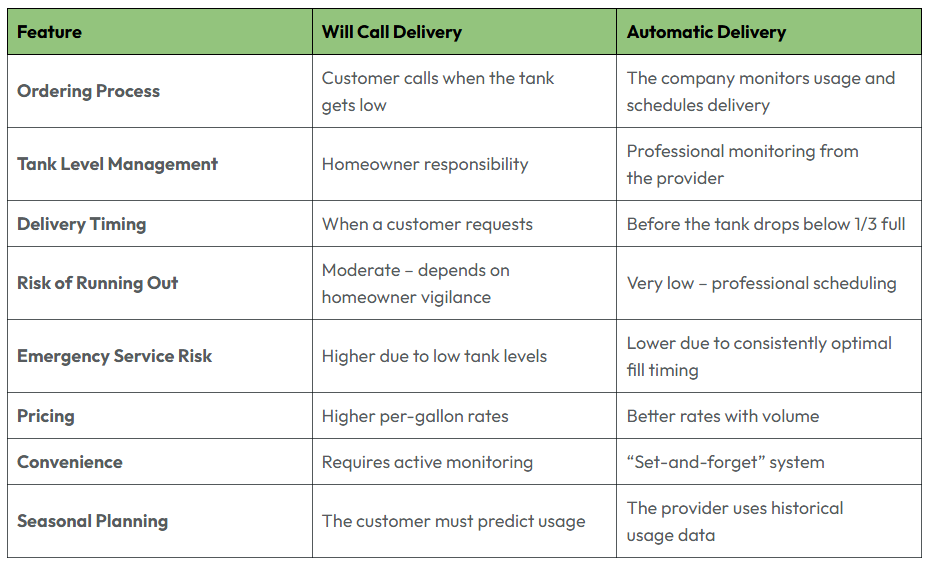
Will Call vs Automatic Heating Oil Delivery Comparison
| Feature | Will Call Delivery | Automatic Delivery |
| Ordering Process | Customer calls when the tank gets low | The company monitors usage and schedules delivery |
| Tank Level Management | Homeowner responsibility | Professional monitoring from the provider |
| Delivery Timing | When a customer requests | Before the tank drops below 1/3 full |
| Risk of Running Out | Moderate – depends on homeowner vigilance | Very low – professional scheduling |
| Emergency Service Risk | Higher due to low tank levels | Lower due to consistently optimal fill timing |
| Pricing | Higher per-gallon rates | Better rates with volume |
| Convenience | Requires active monitoring | “Set-and-forget” system |
| Seasonal Planning | The customer must predict usage | The provider uses historical usage data |
How Will Call Delivery Works
Will-call delivery involves a fuel provider fulfilling orders as they are made by the customer, putting the responsibility for monitoring oil levels squarely on the homeowner’s shoulders. Their job is to check their tank gauge regularly and contact their heating oil supplier when the oil level drops to around one-third of a tank.
This approach offers maximum control over timing and quantity at the cost of convenience and consistency. You decide exactly when to order and how much oil to purchase, so some homeowners prefer this method because they can time deliveries around paydays or budget cycles. However, this system depends entirely on your vigilance and memory. Busy schedules, travel, or simply forgetting to check can lead to dangerously low oil levels and affect the longevity of your heating system.
The Hidden Dangers of Low Oil Tanks
Running your heating oil tank below 1/3 full can lead to serious problems that many homeowners don’t discover until it’s too late. The bottom of every oil tank contains sediment, sludge, and particulate matter that settles over time, and this sediment is usually diluted and carried away by your heating oil without issue when there is enough oil in the tank.
However, if your tank runs low, your heating system can start drawing from these more contaminated bottom layers of oil, drawing in a larger share of sediment than it can handle. This dirtier fuel contains particles that can:
- Clog fuel filters and nozzles
- Reduce combustion efficiency
- Increase particulate matter in exhaust
- Damage heating system components
- Trigger emergency service calls
When contaminated fuel enters the system, it also burns less efficiently and creates more maintenance issues. You’ll notice reduced heat output, unusual sounds, or complete system shutdowns. The repair costs of issues arising from contaminated fuel often exceed the savings from trying to stretch your oil supply. A single service call to clean clogged components can cost $200-400, while a complete system cleaning might run $500-800.
How Automatic Delivery Protects Your System
Automatic delivery eliminates the guesswork and prevents your tank from reaching dangerously low levels. Professional fuel suppliers like Skaggs-Walsh monitor your usage patterns and schedule deliveries when your tank reaches between 1/3 and 1/2 full, far before sediment becomes a problem.
Skaggs-Walsh’s Smart Scheduling Process:
- Historical usage analysis tracks your heating patterns
- Weather data and home size/occupancy metrics are used to refine delivery timing
- Delivery is automatically scheduled to refill as close to your 1/3 tank benchmark as possible
This proactive approach keeps your heating system running on clean fuel year-round. As a result, you’ll experience fewer service calls, better efficiency, and longer equipment life.
Cost Analysis: Hidden Expenses of Each Method
| Cost Factor | Will Call | Automatic Delivery |
| Per-gallon pricing | Generally higher rates | Volume pricing discounts |
| Emergency deliveries | $50-100 premium | Eliminated |
| Service calls due to dirty fuel contamination | $200-800 annually | Rare (if needed at all) |
| Equipment replacement | Earlier, due to contamination | Extended lifespan |
| Time investment | 2-3 hours monthly monitoring | Zero time required |
Emergency deliveries during peak demand are some of the most significant costs that will-call delivery customers tend to incur. These can cost significantly more per gallon, since heating oil providers are usually stretched thin regarding staff, time, and oil. Weekend or holiday deliveries often carry premium charges of $50-100 on top of higher per-gallon rates as well, since providers are usually operating with fewer team members on these days.
Pair this with the above-mentioned service calls for contaminated fuel, which average $300-500 per incident. Homeowners using will call typically face 2-3 such calls annually, adding $600-1,500 to their heating costs.
Which Delivery Method Fits Your Situation?
At the end of the day, it is every property owner’s personal decision which delivery method is right for them. While there are many benefits to automatic delivery, there are ways to extract a lot of value out of will-call if you’re willing to dedicate the extra energy and vigilance to timing deliveries properly.
Choose Will Call If:
- You have predictable heating usage patterns
- Someone is always home to monitor the tank
- You prefer controlling delivery timing precisely
Choose Automatic Delivery If:
- You travel frequently or have busy schedules
- You want to protect your heating equipment investment
- You prefer consistent, predictable service
- You value peace of mind over manual control
Making the Switch to Automatic Delivery
If you decide that automatic delivery is the right option for you, transitioning from will-call to automatic delivery is pretty straightforward. Your supplier will just need a few details:
- Usage History: Past 2-3 years of consumption data
- Home Details: Square footage, insulation levels, heating zones
- Occupancy Information: Number of occupants, typical schedules/time at home
- Tank Specifications: Size, age, and gauge accessibility
Offering this information up front can improve the accuracy of your initial deliveries. However, even without it, most suppliers can estimate your usage patterns within 1-2 delivery cycles and fine-tune scheduling based on actual consumption.
Get Automatic Heating Oil Delivery with Skaggs-Walsh
We provide oil delivery, boiler maintenance, and installation services that NY customers can count on 24/7. We offer the best equipment and friendly, on-time automatic fuel delivery. We respect you, your home, and your time, and we strive to make sure that your problems get solved in a way that gets you the best value for your money.
Contact us today with any questions you have about will-call vs automatic heating oil delivery, and get connected with the team in your area.